Recovered File #001
Rome’s Atomic Empire
The empire did not fall. It learned to contain the fire beneath matter.
- Class
- Alternate History
- Status
- Recovered file, reconstructed in full
- Record
- Imperial divergence
- Source
- Alpine engineering archive
- Filed
- Jul 16, 2026
The surveyor Caelius Naso kept a wax tablet of complaints, and three days into the dig beneath the eastern Alps he wrote that the rock was warm.
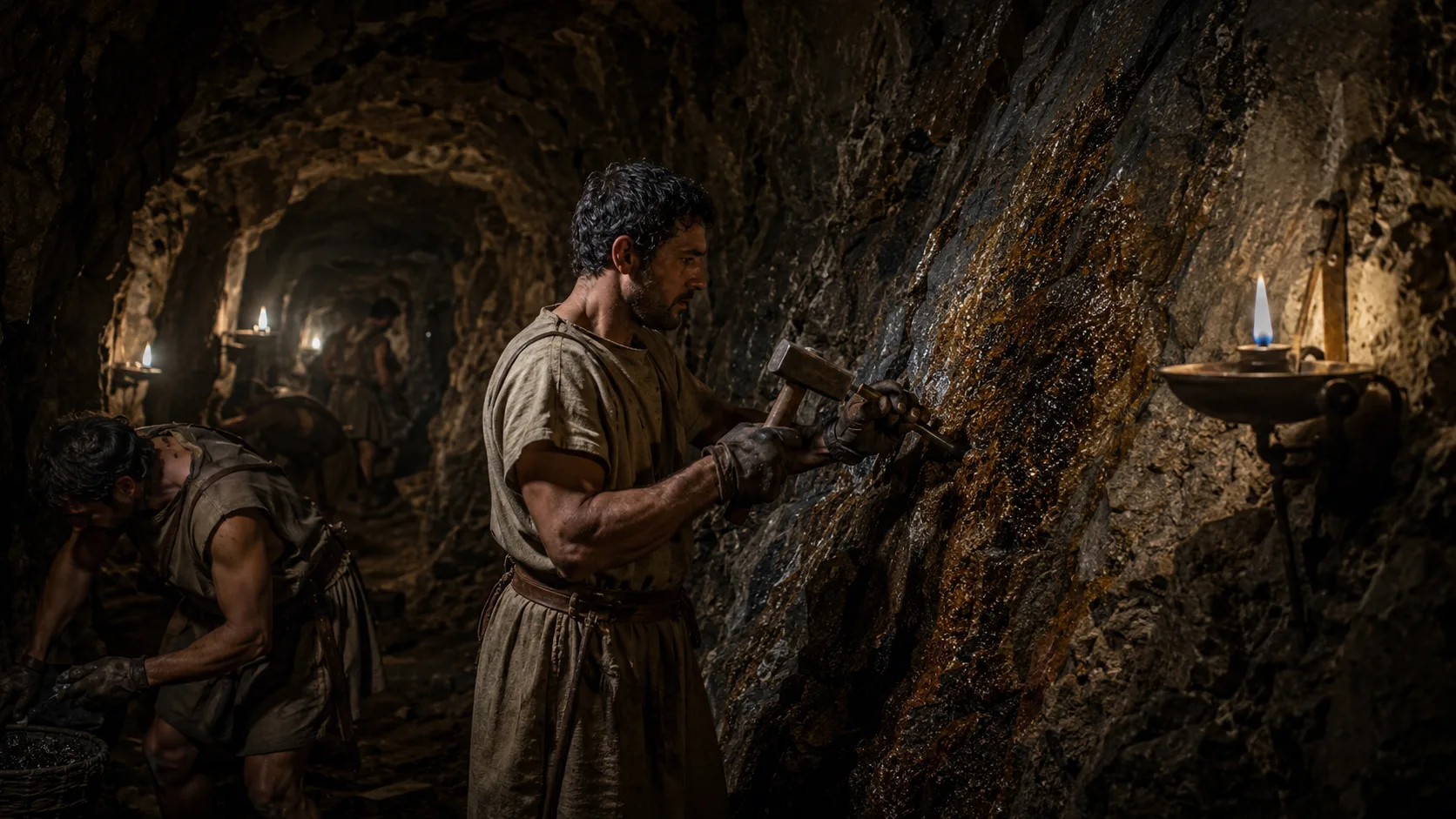 Recovered reconstruction. Alpine engineering archive.
He wrote it plainly, the way a man sets down a thing he does not yet know to fear. The tunnel his crew had cut ran along a seam of dark stone that shed a fine grit into the lamplight and left a taste of hot metal at the back of the throat. Water pooled at the rock face turned milky by morning. Bronze fittings lost their shine in a single shift, and the oil in the lamps burned with a thin blue edge that none of the men cared for. Caelius set all of it down in the flat hand of an official who expected to be reassigned by spring.
Then the work slowed, and he wrote something worse.
Two of his men had laid down their tools and would not eat. There was no wound on either of them and no fever a physician could name, only a weariness that went to the bone and would not lift, and a slow darkening of the skin along the hands and forearms that had handled the stone the longest. One of them, a Ligurian named Rufo who had cut tunnels for the legions for twenty years, sat with his back against the warm rock and told Caelius, quite calmly, that he had not been so comfortable in weeks. Rufo was dead before the new moon, and the man who had worked beside him followed three days later. Caelius sealed the lower gallery with rubble, marked the tablet with the sign he kept for cursed ground, and sent down the valley for someone whose rank was higher than his courage.
By the history most of the world has agreed to keep, none of this ever happened, because by that history Rome was already learning how to end. The frontiers thinned. The roads carried less each year but rumor. The aqueducts that had held up the empire’s confidence for centuries began to fail one arch at a time, and the people who inherited the stone learned to live smaller lives beneath it.
The tablets brought up from the Alpine engineering archive keep a colder account, and in their telling the warm seam did not stay a curiosity for long. A second expedition came the following spring, better prepared and far more frightened. Its men worked in shifts measured against a water clock, wore gloves of boiled leather to the elbow, and lifted the ore into vessels of lead and fired clay without ever letting it meet bare skin. They carried down with them an order under a legate’s seal: the stone was the property of the emperor, its place was not to be spoken of on pain of death, and no man was to warm himself at it, however cold the tunnel grew. Rome did not understand what it had found. No one would truly understand it for a very long time. But the empire had spent eight centuries commanding forces it could not explain, and heat was the oldest of them.
The closed furnace
They built the first furnace the way they built everything, heavily and out of suspicion.
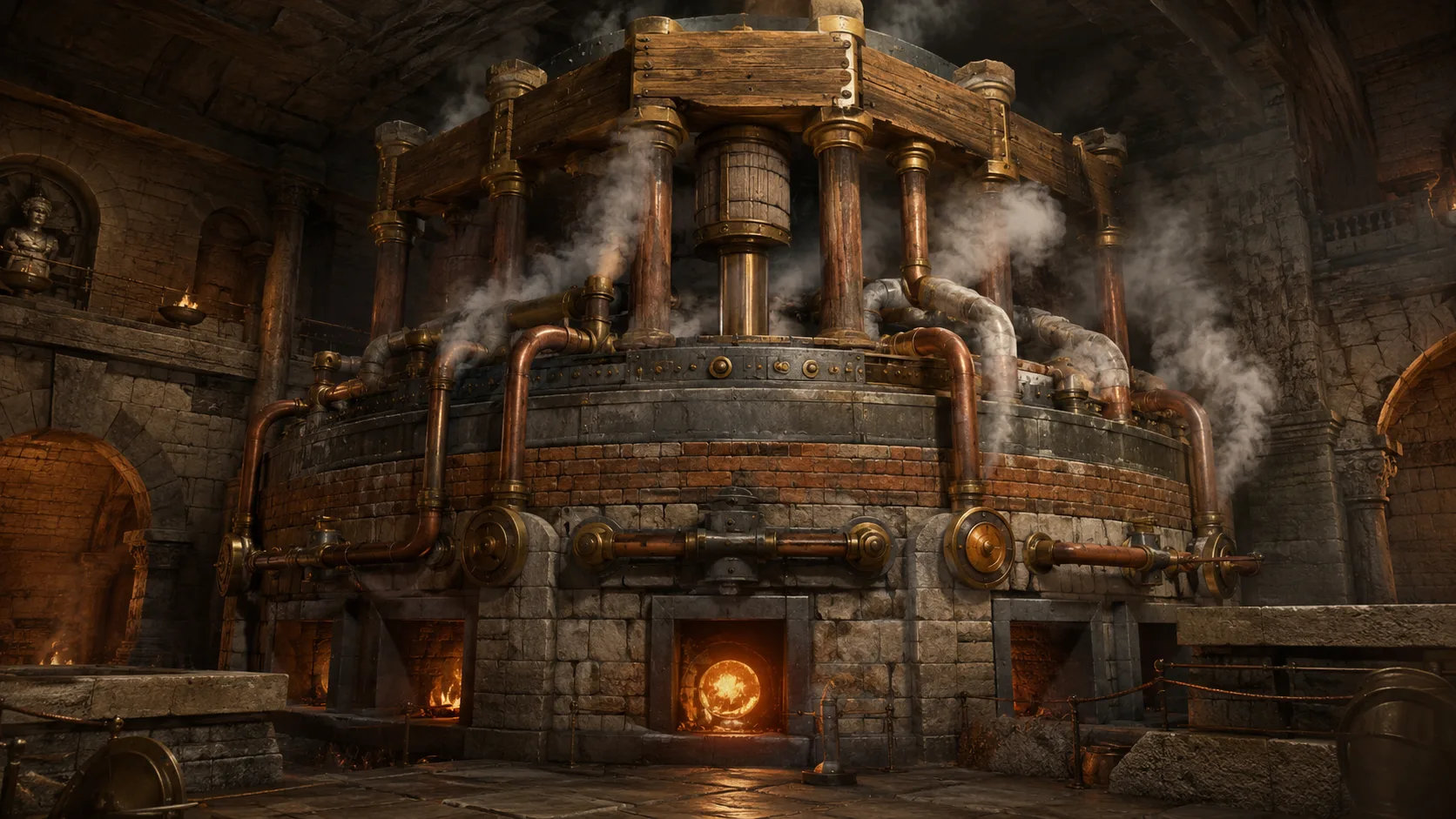 Reconstruction after the works of the engineer Vetranio.
The magister of the works was a Dalmatian engineer named Vetranio, a careful man with a bad leg and a worse temper, who would not let a single course of stone be laid without an inspector at his shoulder. He sank the ore inside nested shells of granite, lead, and kiln-fired brick, each layer thicker than a man is tall, then ran sealed copper channels through the outermost skin so that water could pass close to the heat without ever meeting it. The water came back as steam. The steam drove a great piston of oak bound in bronze, and the piston turned a wheel that had been built, at first, for nothing grander than lifting the tunnel’s own floodwater back to the light.
It worked. It worked slowly, and it wasted most of what it made, and it took forty men to tend what a single mule might have managed in a dry season. The first time the joints held and the wheel came round under its own power, one of the copper unions burst and laid a jet of scalding steam clean across the chamber, and a young engineer lost the sight of an eye before Vetranio dragged the relief valve open with his bare hands. He wrote to the treasury that same night. He told them he had built nothing new. He had built a Roman machine, governed by valves and counterweights and the patience of a large workforce, and its single virtue was this: the fire at its heart asked for no wood.
That one fact bent the shape of the empire. Rome’s reach had always ended where its forests ended, at the last hillside worth stripping for a furnace or a fleet. Now the seam beneath the Alps burned on through winters that would have frozen a marching column where it stood, and the frontier of what Rome could heat and mill and move stopped retreating with the timber line.
The dead valley
Every child raised near the furnace provinces knew the story of Nemus Mortuum, the dead wood, though few could have found it on a map and none were permitted to try.
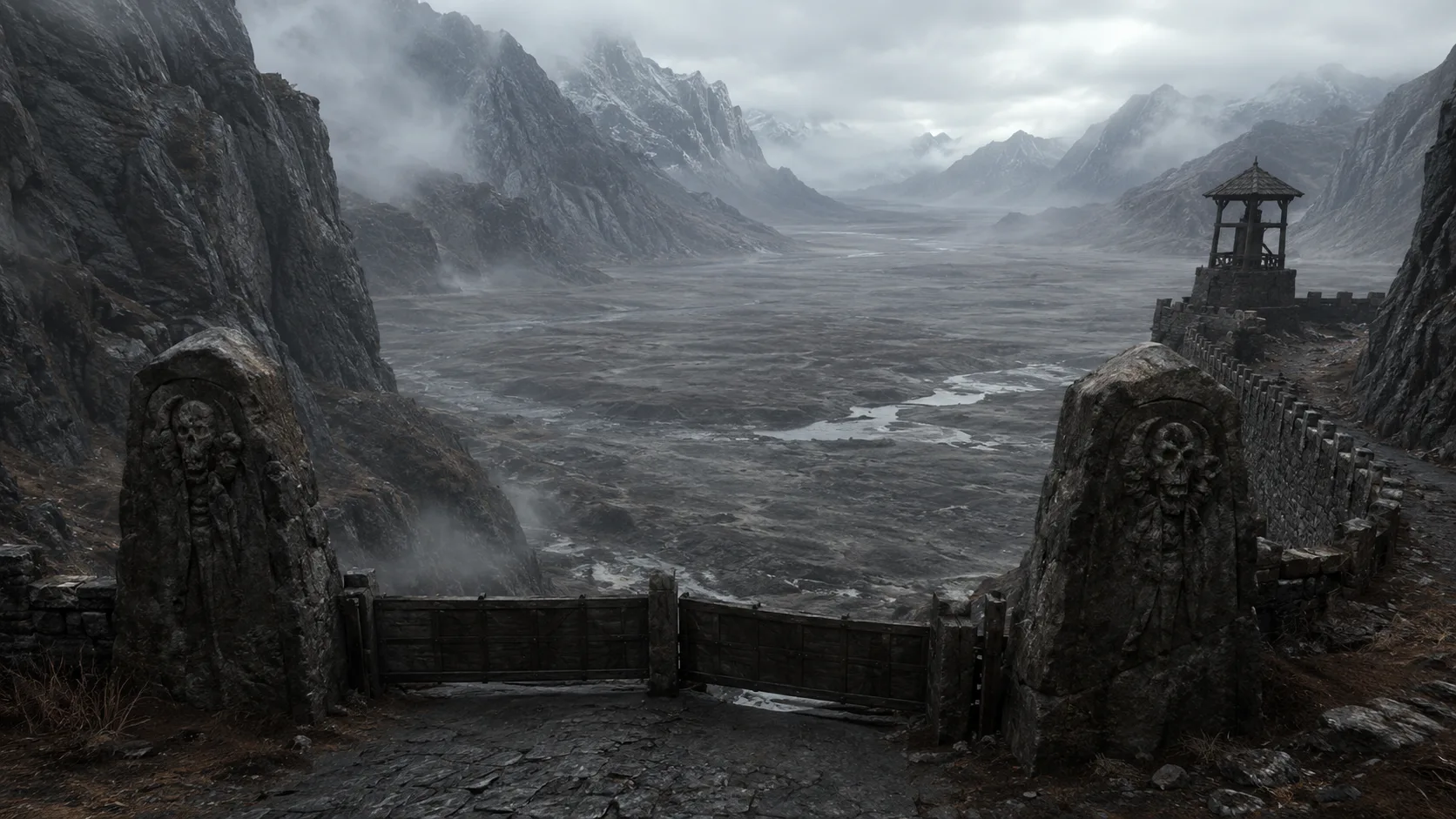 Nemus Mortuum. Exact location withheld in the original record.
In the early years, before the doctrine of containment had hardened into law, an ambitious prefect built a furnace too large and too fast in a green valley two days north of the mines. He wanted steam enough to drive a whole district of mills, and he got it, until a flaw in the innermost shell let the raw ore breathe. The register is spare about what came next. The water turned foul within a season. The livestock sickened and would not breed. The workers left first, then the villages downstream, then the birds, and by the third year the valley had gone quiet in a way that had nothing to do with peace. Nothing green returned to it. The Romans, who were practical people, did not waste years purifying what they could not understand. They walled the head of the valley, set a permanent watch, and cut a new road along the ridge so that no traveler need ever pass through the low ground.
That road still ran a hundred years later. Soldiers who marched it spoke of the way sound seemed to fall into the valley and never climb back out, and of the standing stones the engineers had raised at intervals along the wall, each carved with the same warning that no man living had the authority to remove. The dead valley taught Rome the lesson that shaped everything after it. The fire could be used, and the fire could be sealed, but the fire could never be undone, and a single careless province could poison the ground for lifetimes.
Ignis perpetuus
The people who lived alongside the working furnaces named the fire long before the philosophers did. They called it ignis perpetuus, the fire without fuel, and they meant it the way a farmer means the weather, as something vast and useful and never quite safe.
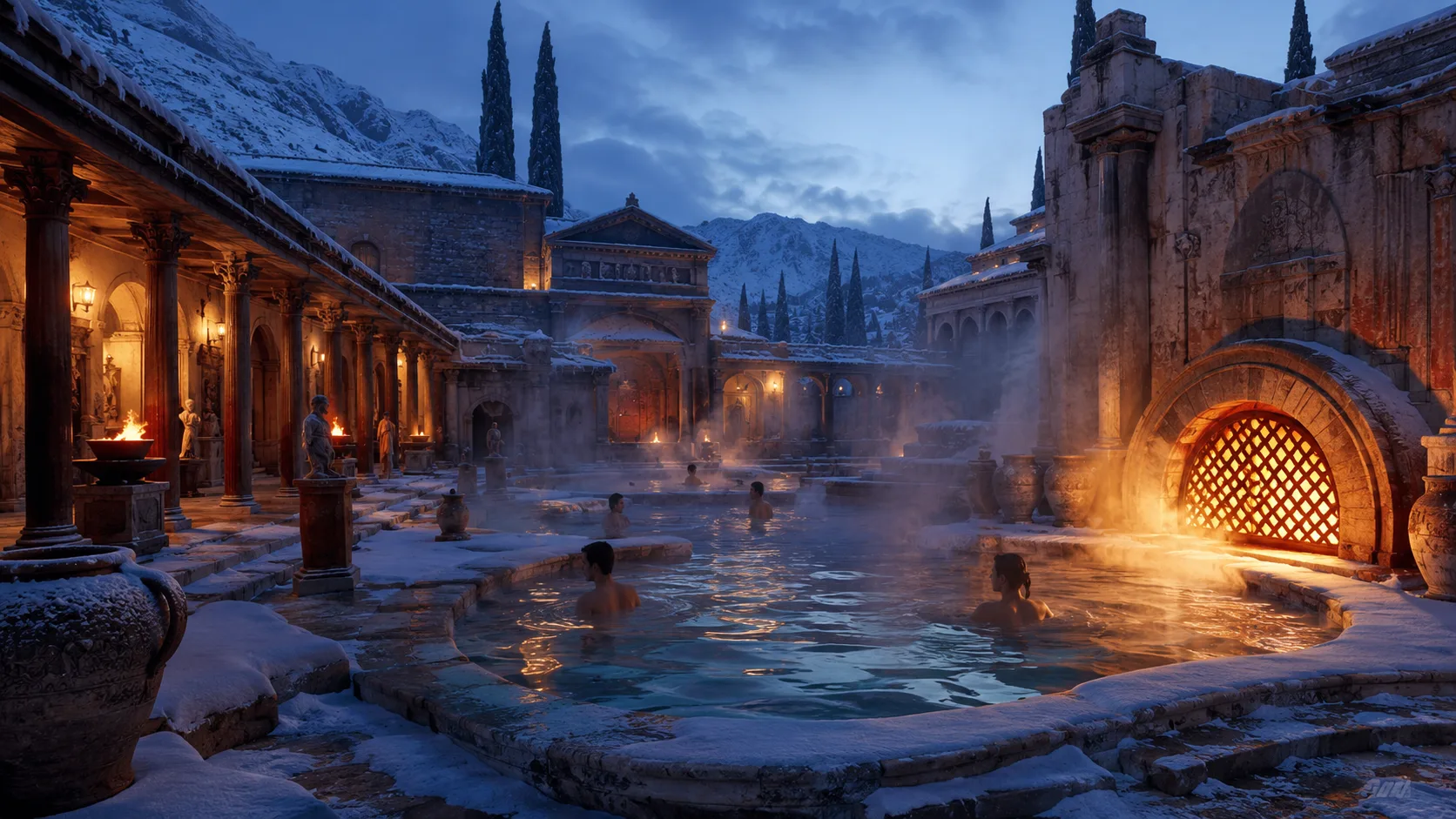 Recovered reconstruction. Northern provinces.
In the northern provinces the bathhouses stayed open through the dark months, their pools breathing steam out into the falling snow. Mills that had always slept when the rivers froze ground grain in the deep of January. Water climbed to districts built above the reach of the old aqueducts, and whole quarters of cold cities gathered themselves around the state furnaces, where a widow could lease an hour of heat to fire a kiln of pots and a boy could warm his hands at a public vent for the price of carrying out the ash. Old men who remembered the lean winters told the young that they did not know how well they lived, and for once the old men were right.
The comfort came wrapped in a bureaucracy that never slept. Every vessel that passed near the fire came away stamped by an imperial inspector. Every worker who went inside the sealed chambers carried a wax tablet that recorded his shifts down to the hour, because the physicians had learned to read the early signs in a man, the gray weariness and the darkening skin, and to pull him from the work before the stone had finished with him. Some provinces kept whole quiet houses on the edge of the mining valleys, where the furnace-sick went to rest and did not, for the most part, come home. The valleys where the seams ran were closed off and made into provinces of their own, administered by engineers and doctors and soldiers who answered a stranger’s questions with silence, and, if pressed, with spears.
The usurper who seized the fire
Once, and the registers are careful to record only once, a man tried to take the empire by taking its fire.
His name was Sabinus, a general of the northern armies, and his reasoning was sound by the logic of every century before his own. Whoever held the granaries held the mob, and whoever held the mob held Rome. So Sabinus marched on the greatest of the furnace provinces, meaning to close his hand around the empire’s throat. He took the valley in a single morning. He took the pumping stations, the containment vaults, and the great furnace itself. What he did not take, because they slipped away in the confusion or simply refused him to his face, were the sealed specialists who alone knew the order of the valves, the timing of the water, and the meaning of the small iron gauges that told a tended fire from a dying one.
Sabinus held a weapon he could not read. Within days the water was running wrong. The chambers grew hot in the wrong places. His own soldiers, camped too long against the walls, began to show the gray weariness that the register never had to name twice. Rome did not march against him, and that was the terrible part, the part the whole story turns on. The empire simply closed the roads to his valley, cut off the trained men and the clean lead, and waited, the way a man waits out a fire in a locked room. By the time the legions came at last it was to wall the head of a second dead valley and raise a second line of warning stones. Sabinus had reached for the empire’s throat and found that it strangled the hand that closed on it.
After that no one tried again. The lesson had been carved into the map itself, in the silence of two valleys where nothing grew.
The empire that could not fall apart
Atomic fire did not make Rome gentle, and it did not make Rome modern. It made Rome impossible to inherit in pieces.
A city that lived on furnace heat could not be handed to a local strongman the way a granary could, because the furnace would kill anyone who ran it without the knowledge kept behind the sealed valleys. A rebellion that once needed only to seize the bread now had to seize the pumping stations, the containment vaults, and the quiet men who alone could keep them from poisoning the ground, and every would-be usurper who studied the fate of Sabinus chose, in the end, the bread he understood.
So the west did not fall. It paid instead, and it paid without pause. The roads stayed open because the furnaces demanded a ceaseless traffic of ore and lead and trained men, and a road that closes is a furnace that dies. The law stayed the same across a thousand miles because a single broken chain of command could turn a river valley into a place where nothing grew for a lifetime. Rome held itself together not out of virtue but because coming apart had become unthinkable in the most literal sense, a thing no sane governor would set in motion.
It never crossed into the industrial age that later worlds would build out of coal and iron and noise. It settled instead into something stranger and quieter, an atomic antiquity of marble conduits and shuttered valleys and fires that no man alive remembered lighting. Travelers who came down from the passes at night wrote of a glow standing behind the containment walls, low and steady as a fallen star, and of the deep silence the guards kept around it.
Rome had found a way to buy centuries. It spent every one of them holding very still.