Recovered File #003
The House Cat That Survived the Jurassic
The largest animals ruled the horizon. The smallest survivor owned the shadows.
- Class
- Impossible Nature
- Status
- Recovered file, reconstructed in full
- Record
- Faunal displacement
- Source
- Uncatalogued natural-history footage
- Filed
- Jul 16, 2026
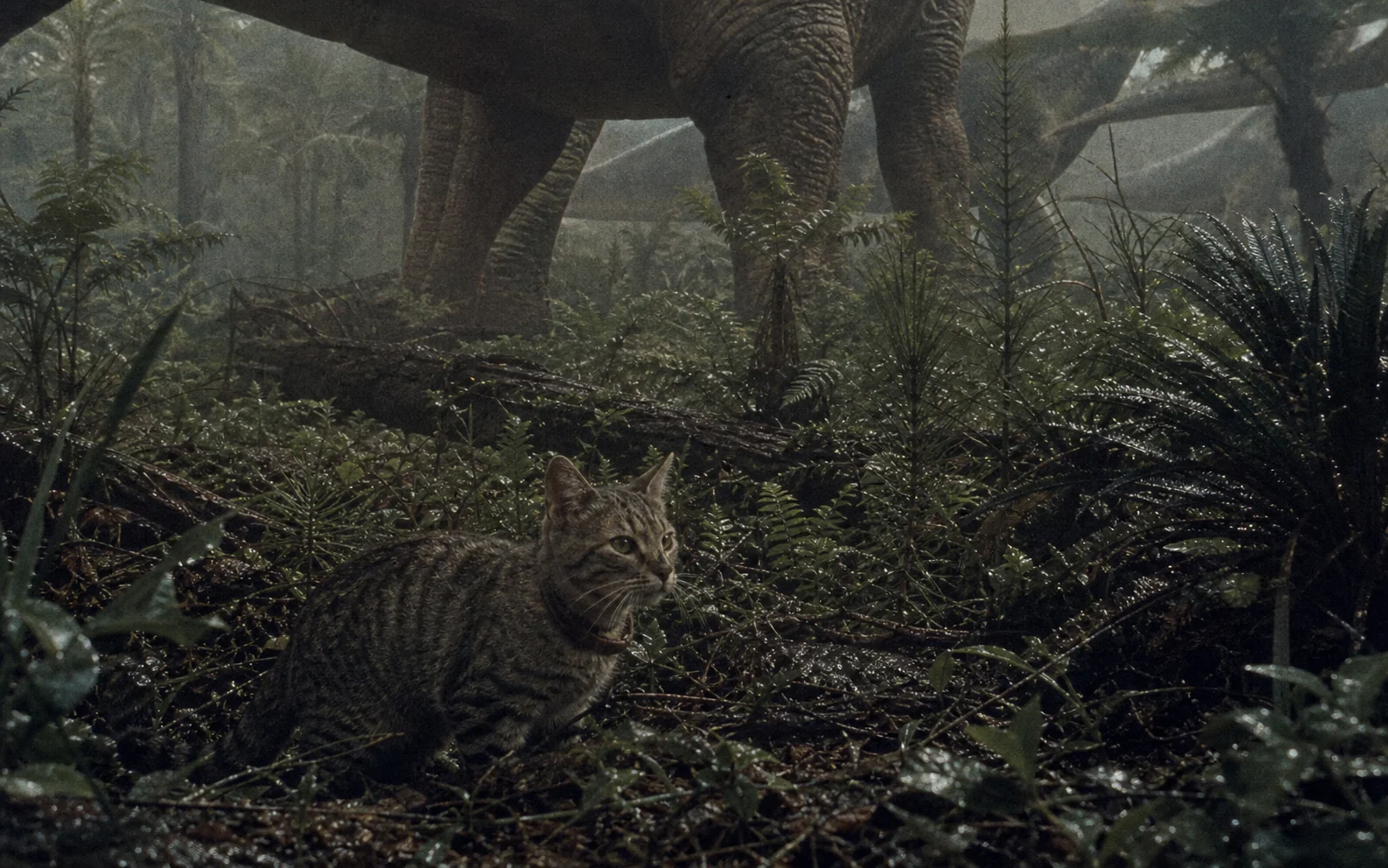
She comes into the Jurassic the way she used to come into a cold room, low and unhurried, one paw and then the next, testing the ground before she trusts it with her weight.
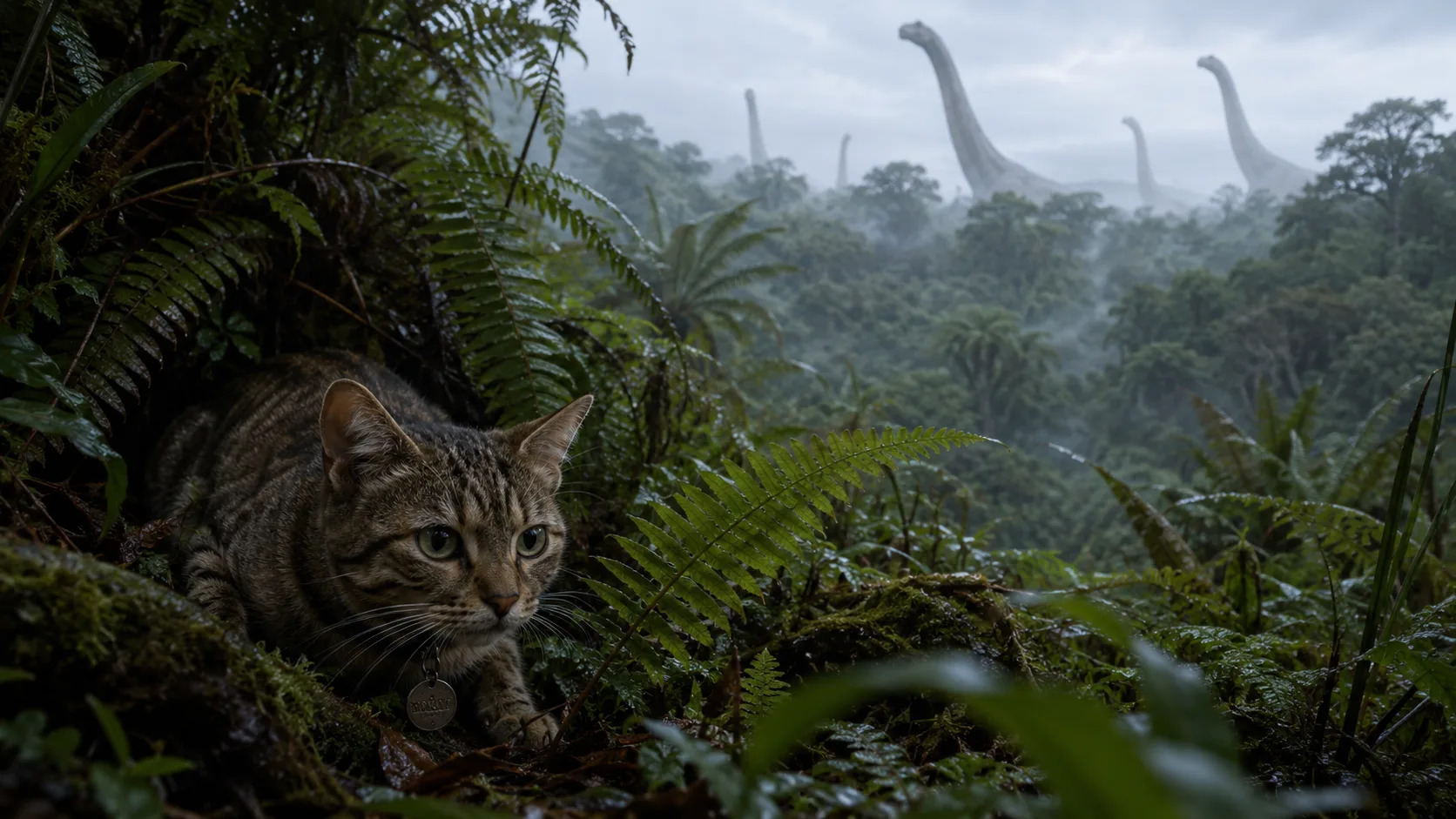 Recovered natural-history footage. Opening frames.
Everything the recovered footage shows around her belongs to a world that has never seen her kind. Cycads stand in the wet heat like squat green fountains. Conifers climb straight past the top of the frame. The air hangs thick with insects the size of a thumb, and far off, above the tree line, enormous bodies move with the slow patience of weather. In the middle of it stands a short-haired tabby with a narrow collar and a small brass tag gone dull, an animal that weighs less than the eggs some of these creatures lay, set down alone in the largest world she will ever know.
She does not try to understand it. That is the first thing that saves her. A dog dropped here might bark at the horizon and announce itself to everything with teeth. A person might walk out into the open to get a better look. The cat lowers herself into the ferns instead, folds her legs beneath her, and goes still, and lets the enormous morning happen without her anywhere in the middle of it.
Below the giants
The great hunters of that forest own the open ground, and open ground is precisely what she has spent her whole small life learning to avoid.
Size makes blind spots. A predator built to pull down something the height of a house does not waste its attention on something the height of a boot, and she keeps to the country such creatures overlook, the low seams of the world where roots knuckle up out of the mud, where a fallen trunk makes a tunnel and a crack in a rock makes a door that only she can use. She moves in the soft hours, the gray slot after dawn and the one before dark, when the heat leaves the ground and the largest animals grow still and heavy with it.
The instincts that once carried her along kitchen counters and garden walls have not changed at all, because they were never really about kitchens or gardens. When a shadow slides across the ferns she becomes a stone. When hunger tells her to move she waits it out, and waits past it again, until the thing she is watching forgets to be careful. And when the ground offers her the one advantage her whole body was built around, she takes it without hesitation. She climbs.
The thing that hunted her
She learns the true price of the open ground on a morning she is careless, and she very nearly does not live to keep the lesson.
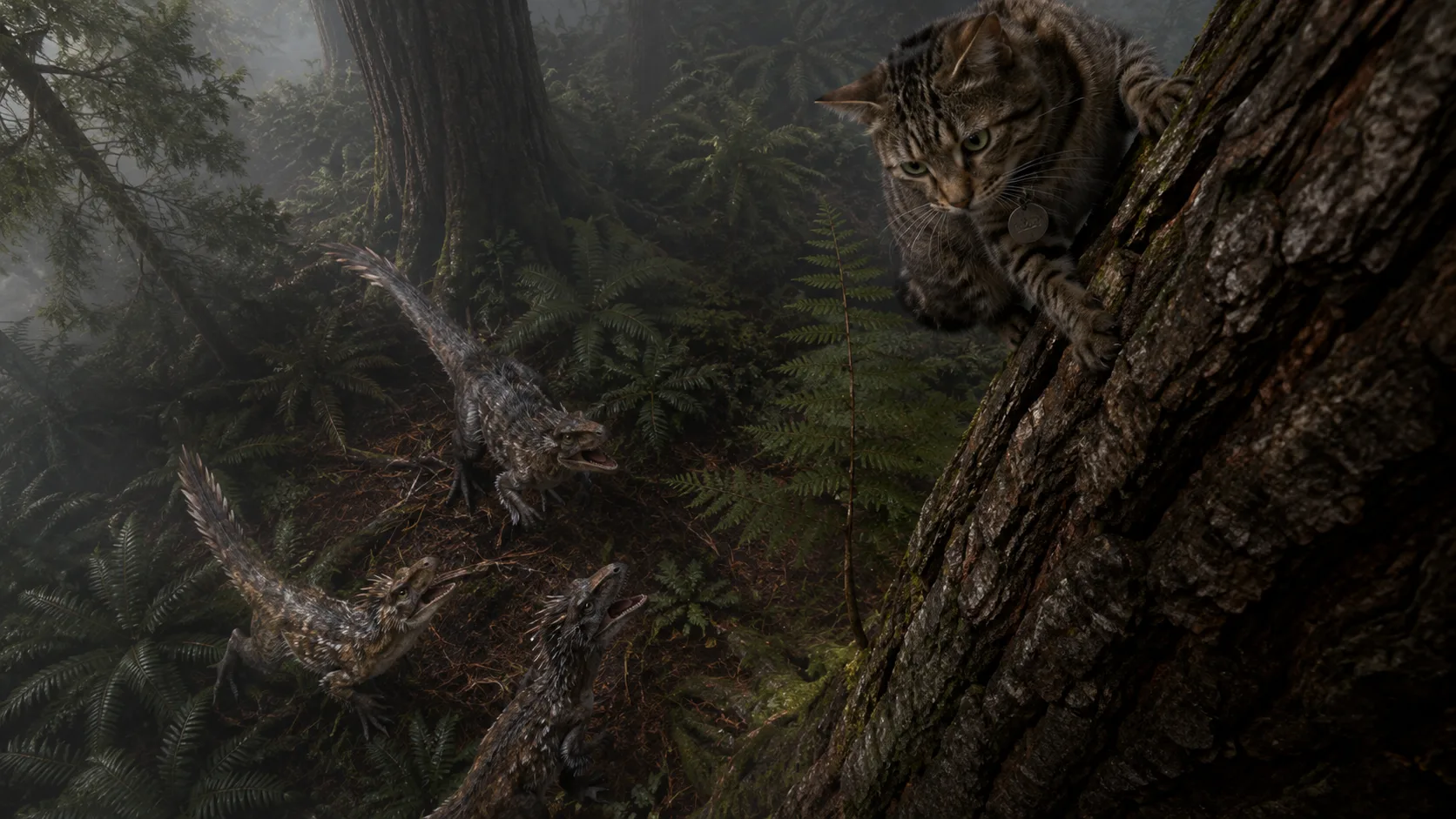 Recovered footage. Frame enhanced.
She is crossing a clearing she has crossed a dozen times, a shortcut between two stands of fern, when the undergrowth on the far side comes apart and three small hunters spill out of it at a dead run. They are nothing like the giants. They are quick and low and about the size of hounds, feathered along the spine, built for exactly the kind of prey that tries to sprint across open ground, and for one frozen instant every one of them is looking at her. Then she is running, and the clearing that took a dozen easy crossings has become the longest distance in the world.
They are faster than she is over bare earth. She knows it before she has taken three strides, feels it in the way the sound of them closes at her back, and so she does the one thing her shape was truly made for. She does not run in a straight line. She cuts, hard and sideways, at the last possible breath, and the lead hunter overruns the place where she had been and loses a full stride recovering it, and that stolen stride is the whole of her life just then. The nearest conifer comes up fast. She hits the bark already climbing, claws finding the seams the way they once found the back of a couch, and she is ten feet up and then twenty before the pack has finished skidding to a halt at the root.
They cannot follow. That is the shape of the bargain in this world, and it is weighted, just barely, in her favor. One of them leaps and its jaws snap shut on nothing a body’s length below her feet. They circle the trunk and call to one another in short harsh voices and settle in to wait, because waiting is a hunter’s oldest tool and they have more patience than a full belly usually allows. She waits longer. She has all the time there is, and she spends it without moving, a small gray knot in the high branches, until the light shifts and something easier stirs off in the ferns and the pack, one by one, gives her up. She does not come down until the forest floor has been empty for a long while. She never crosses that clearing again.
The first kill
Her own hunting, once it settles into a rhythm, is nothing like the work of the things that hunt her.
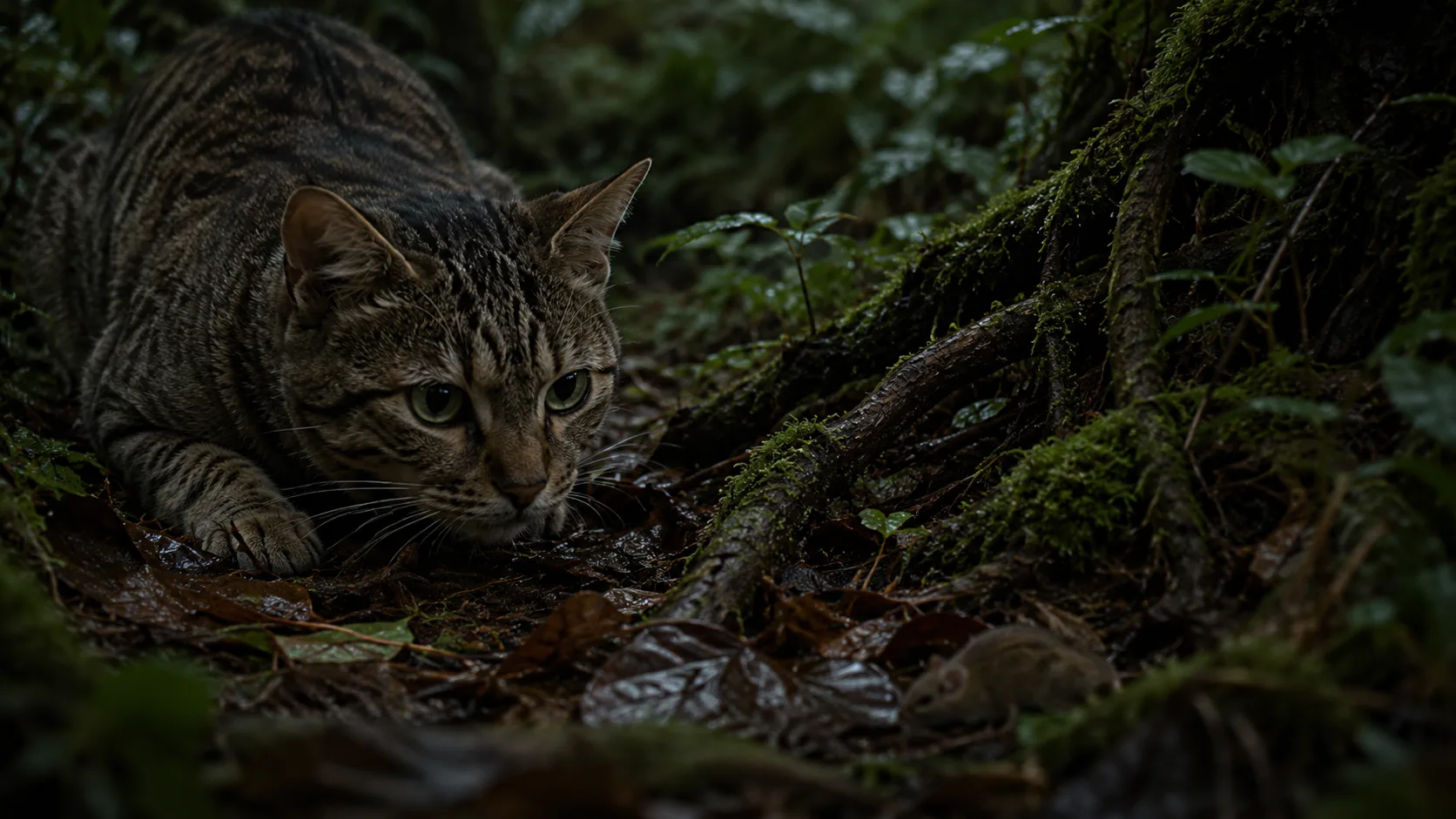 Recovered footage.
Beetles come first, run down in the leaf litter with a pounce she has made ten thousand times on ten thousand toys. Then small lizards, quick but not quite quick enough. Then the low, warm-blooded things that scurry among the roots, the distant grandparents of everything that will one day include her own kind, scarcely larger than the mice she was born knowing how to take. The shape of the hunt is exactly what it would be on a suburban lawn a hundred and fifty million years later. She goes flat. She gathers herself beneath her. She holds so still that the whole world seems to hold with her, and then there is a short hard burst of her across the ground and a bite placed cleanly before the prey can turn its head.
The nests are the great temptation and the great danger both. An unguarded clutch of eggs is more food than she could hunt in a week, and she learns to shadow the big plant-eaters at a distance, drifting in toward their trampled nesting grounds only when the adults have wandered off to feed. But she learns the cost of it just as quickly. The first time the ground shakes with a returning parent she abandons a whole broken egg without a backward glance and is thirty feet up a tree before the fear has finished arriving in her chest. She lives because her curiosity is always on a leash held tight by her caution, and when the two of them disagree, the caution always wins.
A history no one wrote down
The weeks change her the way weeks in the wild change anything at all.
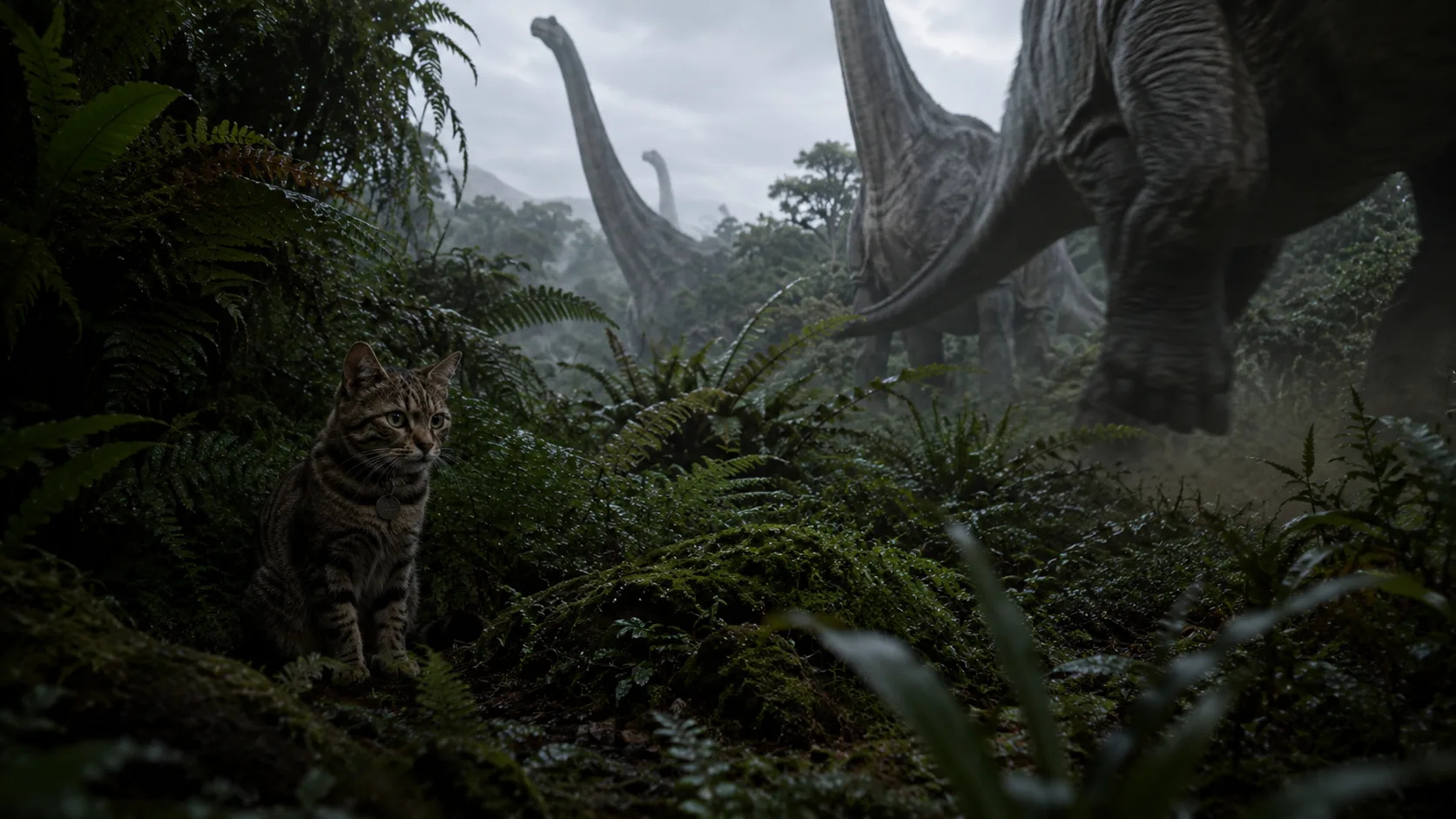 Recovered footage. Final frames.
Her coat roughens and loses its indoor shine. The collar, worried thin by a hundred branches and never once renewed, works its buckle loose one damp night and stays behind in the leaves, and the little brass tag with its small forgotten name goes down into the mud of an age that will never learn to read it. She stops crossing open ground unless something drives her onto it. Her resting places climb higher into the safe dark of the canopy. Her hunting narrows to a few trusted corridors that she walks as surely as she once walked the rooms of a house.
She does not become a monster. There is no swell of music, no single moment where the house cat turns into something the forest has learned to fear. She stays exactly what her kind has always quietly been, a small and endlessly adaptable ambush hunter, content to make a good living at the ragged edge of a world far too large to fight. That, in the end, is the whole trick of her, and it is the reason she is still alive and watching when the footage finally runs out.
The last thing the recovered file shows is a procession of the giants going by beyond the ferns, so close that the picture trembles with every footfall, close enough that you feel each one land somewhere behind the breastbone. The cat sits in the green half-dark and watches them pass. She does not run. She has already learned the only lesson this world had left to teach her, which is that the enormous and the terrible are almost always only passing through, and that the small thing low in the ferns need do nothing at all but keep still, and keep breathing, and wait for the ground to go quiet again.